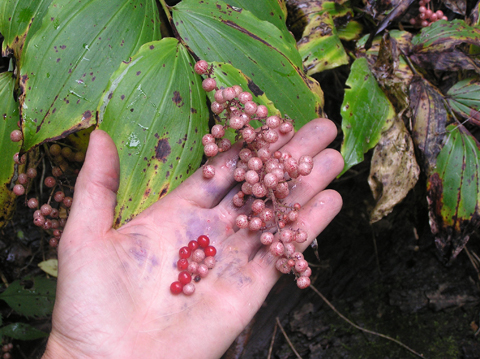
Fruits turn red in September when ripe. Seed can be collected early
before they turn red. They will finish ripening in storage.
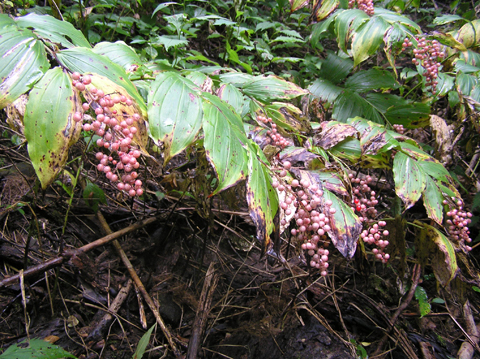
Smilicina produces abundant fruits and often grows in large dense patches.
Species Name: Smilicina racemosa
Common Name: False Solomon Seal
Zone: 3 to 8
Distribution: Ontario Canada throughout the eastern US to
Florida
Seed collection: Seed matures in September. Seed is produced in terminal cluster on the end of each stem. A cluster may contain 50 or more fruits. Some fruit may remain on the plant into November but most will have fallen on the ground if not collected earlier. As the fruit matures the color changes from light green to cream with red flecks finally changing to bright red. Harvest all of the fruit when a few fruits in a cluster have turned red. The flesh on fruits that have not completely turned to red will still be hard but the fruits will finish ripening in a few days. Strip the seed from the plants by hand.
Seed handling: FSS seed should be cleaned for storage, the pulp contains a chemical inhibitor that delays germination. Each fruit contains one perfectly round porcelain white seed. Remove the pulp and skins from the seed soon after collection or the fruit will begin to ferment which may affect seed viability. The pulp and skins are easily removed by macerating the fruit with your hands. Large batches can be macerated using a food processor. Blend until the skins and pulp are pureed. Processing will not damage the white seeds. Separate the pulp and skins from the seeds by floating off the waste. Sound seeds will sink to the bottom of the container and aborted seed, skins and pulp can be poured off with several changes of water until only sound seed remains.
Germination requirements: Seed requires warm moist stratification for 1 to 2 months, then cold moist for 3 to 4 months. Seed may require repeated cycles of W/C/W/C before germination occurs. A few seed may germinate the first spring but most seed will take 2 years or more to overcome dormancy. Early seed collection, cleaning and stratification will help speed up germination. Sow seed directly into native soil where you want the plants to grow or into prepared seedbeds. Press the seed into the soil surface about ¼” to ½” deep.
Ecology: False Solomon is an important long-lived perennial understory herb providing both food and cover for wildlife. It can be found in a range of woodland habitats, from rich bottomland forests to dry rocky upland forests. It is most abundant on deep rich soils in light to deep shade in association with a host of other woodland herbs such as trillium, hepatica, wild ginger and wild leek. It can grow in large patches or as part of a diverse herbaceous community. The fruits are eaten by several species of woodland birds and small mammals. FSS shows a degree of deer resistance to browsing. Deer will feed on the foliage but generally do not prefer it. FSS is easy to naturalize in the wild. Encourage its widespread establishment by collecting the abundant fruit in the fall and planting it directly in the soil, or if time is limited, simply disperse the seed by broadcasting.
Fruits turn red in September when ripe. Seed can be collected early
before they turn red. They will finish ripening in storage.
Smilicina produces abundant fruits and often grows in large dense patches.
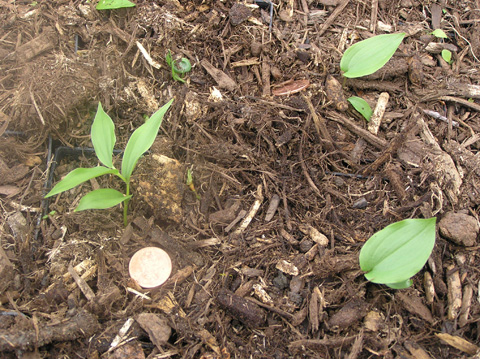
False solomon seal first true leaves shortly after germinaton.
Seedlings remain quite small the first growing season.
Seedlings may have only one leaf or sometimes two or three the first season.
The plants will get progressively larger each succeeding year.
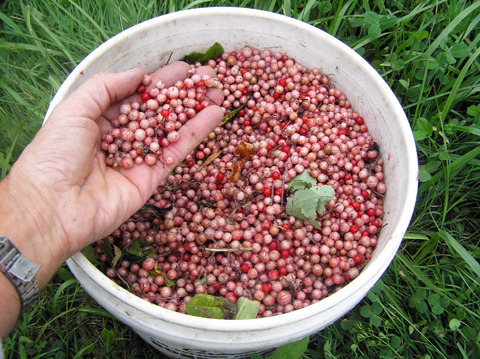
Collect large quantities of fruit and plant or broadcast into new areas to estalish new populations.
This page last update on January 5th, 2011