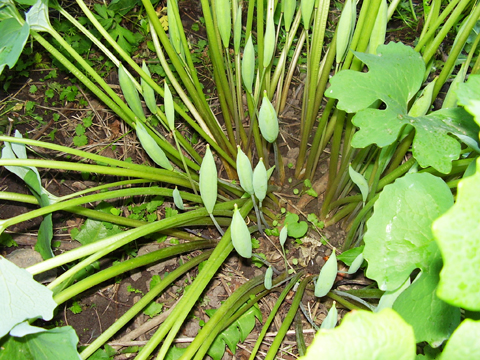
Blood root seed ready for collecting
Species Name: Sanguinaria canadensis
Common Name: Blood Root
Zone: 3 to 9
Distribution: Found from Canada; Ontario and Nova Scotia in the east, south to Florida west to Oklahoma and then north to Manitoba
Seed collection:Seed matures in late spring. In the Northeast from the last two weeks in May to the first week in June. The seed is held in long tapered pods that develop on the ends of the flower stalks. Monitor the pods closely, watch for a subtle color change from green to yellow. The seed will turn from white to cream and then a reddish brown color when mature. When seed reaches maturity the pods will naturally split open spilling the seed. Early harvest will aid in collecting the pods before the seed is dispersed. Harvest all the pods at once as soon as the first pods split easily to the touch. Rub pods over a screen mesh to separate the seeds.
Seed handling: Seed can be planted immediately or stored for later planting. Do not allow seed to dry as seed loses viability rapidly. Placing seed directly into the soil gives good results with a high percentage of germination occurring the following spring. Seed stored for later planting should be stratified in moist potting media for spring planting the following year. Each seed has a white structure attached to it called an eliasome. The eliasome is a food rich structure that has evolved to attract ants. The ants carry the eliasome with the seed attached back to the nest where the eliasome is eaten and the seed discarded, in this way the Blood roots’ seed is transported a distance from the parent plant. The eliasome may unwittingly be misidentified, as a root or shoot, but this structure has nothing to do with germination.
Germination requirements:Seed requires a period of warm/moist stratification followed by cold/moist stratification to overcome seed dormancy. Seed can be stored in a refrigerator for one to two months but the seed may begin to germinate prematurely; a better method is to stored the seed under outdoor temperatures to satisfy the chilling requirement. Seed should germinate the first spring if planted immediately after collecting or given the proper sequence of warm/cold stratification. Plant the seed in natural soil where you want the plants to grow. Press the seed into the soil surface but not deeper than ½”.
Ecology:Bloodroot is one of the easier woodland species to grow and propagate from seed. The seed is abundant; easy to collect and seed readily germinates. Bloodroot grows in part sun to full shade in moist to average woodland soils. It is adaptable to a range of soil and horticultural conditions but grows best in rich deep well drained soils. It’s woodland associates are Sugar maple, Ash, Linden, False solomon seal, Wild ginger, Wild geranium. Bloodroot can grow as part of a diverse woodland herb community or it can grow in nearly pure drifts throughout the woodland. The foliage will persist throughout the summer if sufficient moisture is available or it will go dormant under dry summertime conditions. Bloodroot plants are relatively short lived but populations are easily sustained by self-sowing. It is easy to establish large new populations of Bloodroot or expand existing ones by planting or broadcasting seed into new areas.
Blood root seed ready for collecting
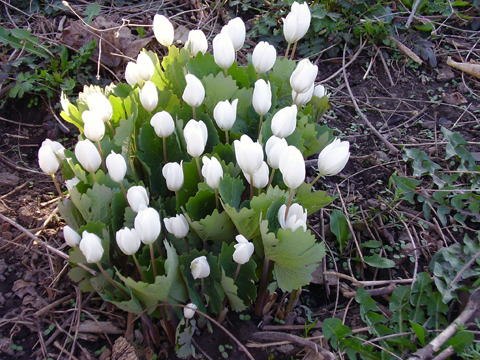
Blood root flowers
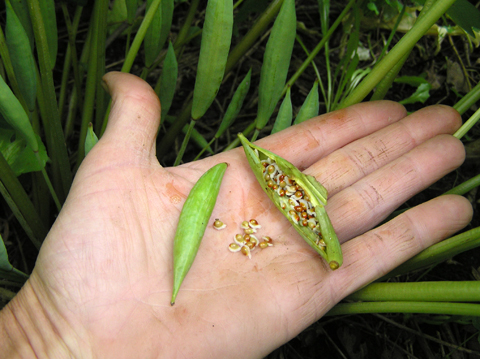
Bood root seed pods
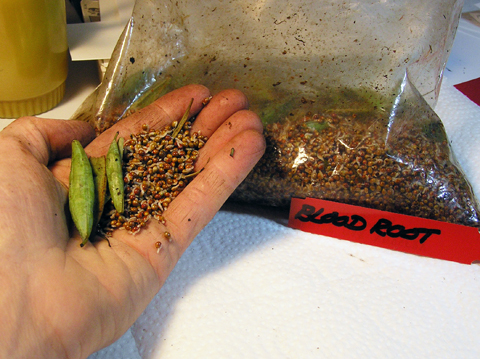
Blood root seed is easy to collect. Use seed to establish new populations of Blood root in degraded habitat .
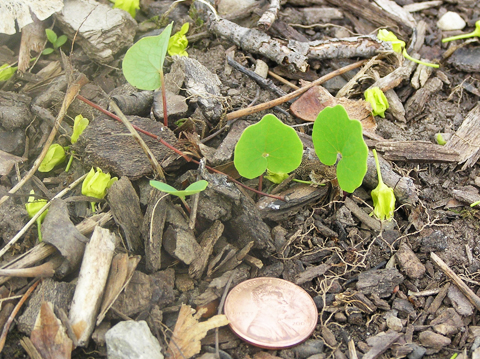
Blood root seedlings shortly after germination.
The first true leaves have a vague resemblance to mature leaves in shape.
As the leaves grow they take on more and more the appearance of mature leaves.
this page updated January 5th, 2011