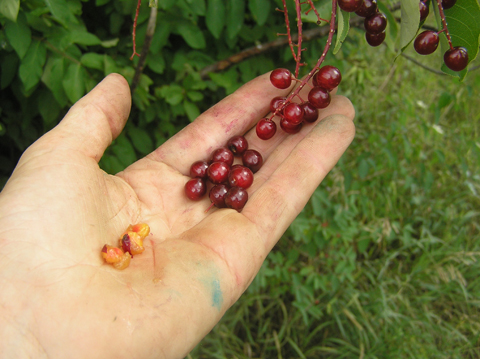
Collect fruits when they change color from green to red and then a dark redish purple.
Species Name: Prunus virginiana
Common Name: American Chokecherry
Zone: 2 to 6
Distribution: Southern Canada From British Columbia in the west to Newfoundland in the east south to North Carolina westerly to Texas and California
Seed collection: Begin collecting seed in late July through August. Seed is mature and ready for collecting when the fruit changes color. Fruit will go through a series of color changes from green to a bright red and then gradually turn a deep purplish-black. Seed should be collected soon after it ripens. Seed is readily eaten by many song birds as there are few other fruits available at this time of year. Little seed will be found just two weeks past maturity. Large flocks of Black birds can descend on heavily laden trees and strip them bare. Many small mammals such as raccoons, possum and fox also relish chokecherry fruit in season. Uneaten fruit that remains on the tree will shrivel and fall to the ground. Fallen seed and seed dispersed by birds and mammals is subject to seed predation by seed predators such as mice and chipmunks. Plants growing in full sun will produce the most fruit. Some trees will produce so much fruit that from a distance they have a reddish or purplish cast.
Seed handling: The fruit of American chokecherry (AC) consists of a small hard pit surrounded by a fleshy pulp. The pulp and skin should be removed from the seed soon after collection or the fruit will quickly begin to ferment and decay. The pulp and skins are easily removed from the seed by macerating the fruit with your hands. Large batches can be macerated using a food processor. Blend until the skins and pulp are pureed. Processing will not damage the hard pits. Separate the pulp and skins from the seeds by floating off the waste. Sound seeds will sink to the bottom of the container and aborted seed, skins and pulp can be poured off with several changes of water until only sound seed remains.
Seed should not be stored dry. Seed can either be planted immediately or placed in a moist potting mix for stratification. Two to three months of cold/moist stratification is usually sufficient to overcome embryo dormancy. Seed can be fall or spring seeded into prepared seedbeds or direct seeded into natural soil. Stratified seed often begins germinating in storage prior to planting. Germinating seed can be planted in individual pots or in seedbeds but make sure the emerging root is pointing down.
Germination requirements: A very high percentage of AC seed will germinate the first spring if cold/moist stratified for 2 to 3 months or immediately fall planted. A certain percentage of seed that does not germinate the first spring will germinate the following year or even later. Sow seed ¼ to ½” deep in prepared seedbeds or in natural soils. Seedlings will grow from a few inches up to 6 to 12” maximum the first year, depending on weed competition and growing conditions. Seedlings will grow in full sun to half shade. Artificial shade can be provided or seed planted under natural vegetation. Seedlings are very vigorous and can effectively compete with weeds under natural conditions. In natural plantings place seed in contact with the soil where there is minimal competition from dense grass and perennial weeds. Old-fields and land with a mix of shrubs and trees is ideal habitat for establishment of PV.
Ecology: American chokecherry is a valuable large shrub or small tree especially useful for naturalizing at the old-field stage of succession. AC suckers freely from its roots and can form dense spreading clumps. It may also grow into a small tree to 20ft in height. It grows under an extremely wide range of soil, pH and moisture conditions, tolerating very poor dry soils to heavy clay soils that are poorly drained.
AC can be expected to grow in nearly any habitat except very wet saturated soils. It can be found growing in full sun to full shade but AC seldom produces fruit in shade. AC is frequently found growing in hedgerows, forest margins and in old fields. Chokecherry readily colonizes disturbed habitats, waste places and early successional lands because of its adaptability and tolerance of adverse growing conditions. Its abundant fruit production and widespread dispersal by birds and mammals makes AC a common and widely distributed small tree.
Collect fruits when they change color from green to red and then a dark redish purple.
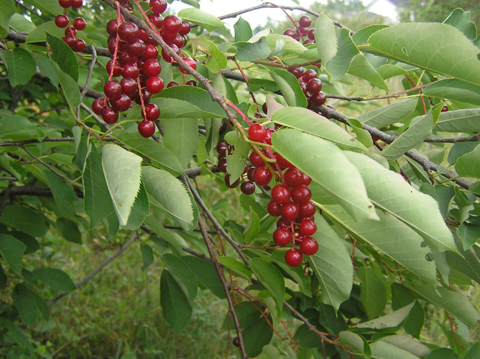
Fruits ready for harvest
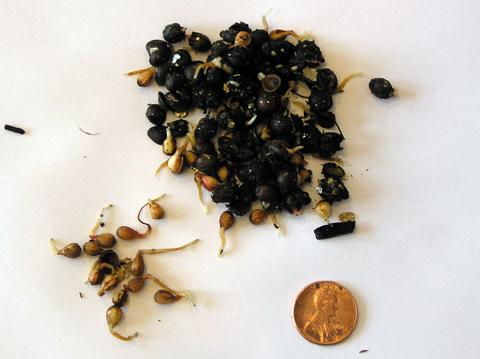
Cherry seed germinating during stratification.
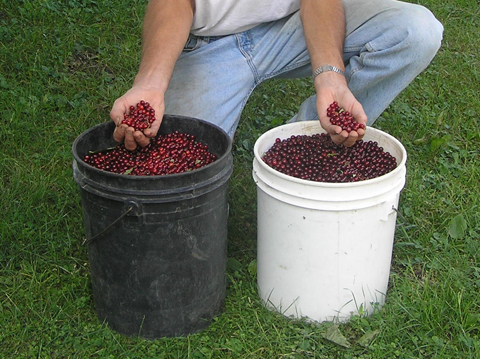
Cherry seed is abundant, it takes just a few hours to collect are large quantity. Use the abundant seed to restore large natural areas..
this page posted January 5th, 2011