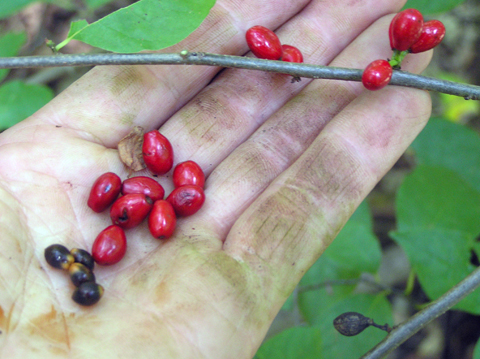
Lindera fruit ready for collection, remove pulp from seeds.
Species Name: Lindera benzoin
Common Name: Spice Bush
Zone: 4 to 9
Distribution: Ontario Canada throughout the eastern US to
Florida. West to Iowa, Missouri
and Texas.
Seed collection: Spice bush (SB) seed matures in late August into mid September in the northeast. The fruit changes color from green to scarlet red over a two to three day period to signal maturity. Seed should be collected from the tree as soon as it turns color. Strip fruits from the branches by hand. LB fruit is produced in small clusters of 3 to 4 or as individual fruits spaced along the stem. The fruit is high in fat and lipids, which makes it a desired food for migrating songbirds. The birds will often begin to eat the fruit even before it has fully ripened. You can harvest the fruit just as it begins to turn color to beat the birds. Uneaten fruit remains on the plant for only a couple of weeks, as the fruit will begin to rot and fall to the ground.
Seed handling: SB seed is surrounded by a highly aromatic fleshy pulp that gives the species its name. Each fruit holds a single brown oval seed. The seed should be cleaned after harvest. Place fruit in a plastic bag for one to two weeks to hasten decomposition and softening of the pulp. When the fruits are soft, macerate by hand and remove the pulp and skins by floating off in several changes of water; sound seed will sink to the bottom. DO NOT use a food processor to clean SB seed, as the seed is too soft to handle this cleaning method. The seed should not be allowed to dry out after cleaning or it will quickly lose viability. The cleaned seed can be planted immediately in prepared beds, under natural conditions in native soil or mix with moist potting mix to begin cold/moist stratification for storage until spring. Cold/moist stratification for 1 month under warm temperatures and two to three months cold is usually sufficient to overcome seed dormancy. Fall planting in prepared seedbeds or under natural conditions will satisfy all the conditions for germination.
Germination requirements: A high percentage of viable seed will germinate the first spring, some seed will germinate the second spring. Sow seed ¼ to ½” deep in prepared seed beds or in native soils. Seedlings will grow just a few inches to six inches tall the first year depending on growing conditions. Seedlings require about half shade the first one or two growing seasons but then can handle full sun. Shade can be provided by artificial screening, by planting under natural vegetation in the open or in the shade of the woodland understory. Soils can be neutral to slightly acidic, be high in fertility and have uniform soil moisture. Seedlings will adapt to lower moisture levels if the site has rich soils and shade. Seedlings are difficult to transplat and are slow to recover because of the fibrous root system. When transplanting try to disturb the roots as little as possible and maintain soil on the roots when possible. Container culture gives better results than moving plants bareroot.
Ecology: Spice bush is an important wildlife shrub that grows in the woodland understory. LB is tolerant of wet poorly drained soils where it is frequently found in floodplain forests, rich bottomland forests and swamps; making up a large component of the shrub layer. It also readily grows on dryer upland sites. LB is tolerant of high pH soils so is frequently found on calcareous soils. It can reach a height of 12ft at maturity but is typically 6 to 8ft high and wide. It has sparse open branching in shade or becomes quite dense and wide in the open. LB is an important shrub of the woodland understory community. It tolerates a high level of shade and provides woody structure and nesting cover in the understory for woodland birds. SB can be easily introduced into new habitat from seed, collect large quantities of seed in the fall and then plant in the soil or broadcast the seed if time is limited.
LB is dioecious; producing male and female flowers on separate plants. Both male and female flowers are yellow, flowers open in early spring along the stems on young twigs from the previous year. Most plants sold commercially are grown from seed, as it is nearly impossible to root LB from cuttings. Seed grown plants cannot be sexed until they reach flowering age which ranges from three years up to several years.
Lindera fruit ready for collection, remove pulp from seeds.
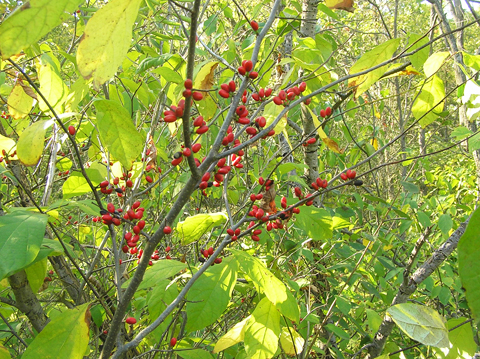
Fruits is produced only on female plants. both male and female plants needed for cross pollination.
this page posted January 5th, 2011