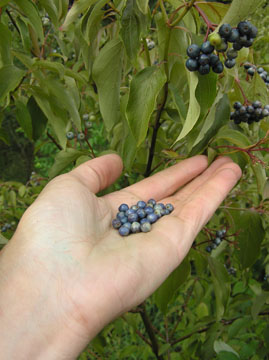
Fruits ready for harvest
Species Name: Cornus amomum
Common Name: Silky Dogwood
Zone: 4 to 8
Distribution: Southern Quebec, Maine and Minnesota in the
north, south to Georgia, Arkansas and Oklahoma
Seed collection: Silky dogwood (SD) fruit matures in early September in the northeast. Fruit changes color from green to bluish white gradually deepening to porcelain blue. Fruits may remain on the plant through October. Some fruit may remain into November. The fruits are readily eaten by many species of birds especially during fall migration and small mammals that may strip plants of all their fruit. Collect fruits from the branches soon after ripening. Collect large quantities of fruit for use in restoring degraded habitat.
Seed handling: Fruit is a small berry about the size of a pea. Each fruit contains one small round hard seed surrounded by a thin fleshy pulp. Clean seed soon after collecting.
The pulp and skins are easily removed from the seed by macerating the fruit with your hands. Large batches can be macerated using a food processor. Blend until the skins and pulp are pureed. Processing will not damage the hard seeds. Separate the pulp and skins from the seeds by floating off the waste. Sound seeds will sink to the bottom of the container and aborted seed, skins and pulp can be poured off with several changes of water until only sound seed remains. Place cleaned seed under stratification within one to two weeks of cleaning to maintain moisture content of seed. Cleaned seed can be sown immediately in prepared beds, planted into native soil or stratified for planting in the spring. Seeds require 3 to 4 months cold/moist stratification to break dormancy or fall plant.
Germination requirements: A high percentage of viable seed will germinate the first spring, additional seed may germinate the 2nd spring. Germination is often delayed until the 2nd spring if the seed has not been cleaned or the seed has been allowed to dry out. Sow seed ¼” to ½” deep in prepared seedbeds or in natural soils. Seedlings emerge in early spring as soon as the soil warms. Seedling growth depends on soil fertility, moisture and weed competition. Seedling size can range from a few inches to 10” tall the first summer. Seedlings can grow in full sun to half shade the first season but shade is generally recommended for the first year.
Ecology: Silky dogwood is an important native wildlife shrub. SD produces abundant fruit, which is a preferred fall food for many birds and small mammals. It is adaptable to a wide range of soil and moisture conditions from dry to average especially adapted to wetlands and poorly drained soils. It grows best in full sunlight but will tolerate partial shade. SD is common in bottomland forests, flood plains, swamps, along streams and any place with excess moisture; it also readily naturalizes in old fields undergoing succession, roadsides and waste places. Silky dogwood grows from 6 to 8 ft tall but occasionally reaches 10 ft. It can be easily established by seed under natural conditions by harvesting large quantities of seed and either planting or broadcasting the seed into suitable habitat. SD should be used as a dominant shrub species making up a large percentage of the established woody plant community in early successional habitats, old fields and wetlands. Silky dogwood has many uses for residential and commercial landscapes. It can be used as a tall ground-cover, planted to stabilize slopes, cover swales, fill large spaces, hide utilities, as a hedging plant, privacy screen or wind break.
Fruits ready for harvest
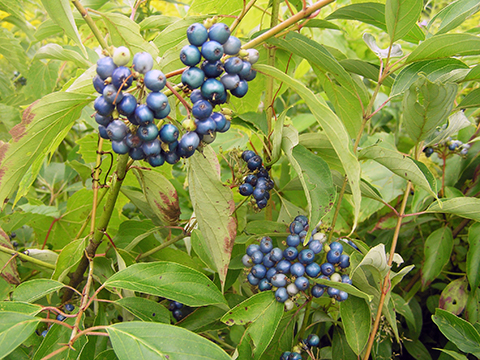
Cornus amomum with heavy fruit set
this page posted January 5, 2011