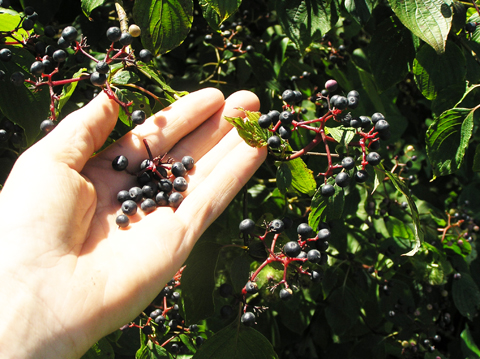
Collect fruit in late August before consumed by birds.
Species Name: Cornus alternifolia
Common Name: Pagoda dogwood, Alternate leaf dogwood
Zone: 3 to 7
Distribution: Found from Canada; Newfoundland and Nova Scotia in the north across the east to Georgia in the south, extending west to Arkansas and Minnesota in the north.
Seed collection: Begin collecting seed in late August through mid September for best results. Seed is mature and ready for collecting when it changes color from green to bluish-black. Seed can be hand picked from the tree or knocked onto a sheet laid on the ground. Collect seed as soon as it changes color as the fruit is readily eaten by many songbirds and does not remain on the plant for very long. If the seed is not eaten by birds it will either dry on the stems or quickly fall to the ground after a few weeks. Plants growing in open areas in full sun produce the most seed and can easily be reached from the ground.
Seed handling: The fruit of Cornus alternifolia consists of a small hard seed surrounded by a thin covering of pulp. Remove the pulp and skin from the seed after collection as most fruits and berries contain a chemical inhibitor that delays germination.
The pulp and skins are easily removed from the seed by macerating the fruit with your hands. Large batches can be macerated using a food processor. Blend until the skins and pulp are pureed. Processing will not damage the hard pits. Separate the pulp and skins from the seeds by floating off the waste leaving only the seed behind. Seed that sinks to the bottom are fertile, seed that float are infertile and should be discarded with the pulp.
Seed should not be allowed to dry out as this will delay germinate or actually kill the embryo. The cleaned seed can be planted immediately, stored moist for up to 1 month or cold/moist stratified in moist potting mix for storage until spring. Two to three months cold/moist stratification is usually sufficient to overcome seed dormancy. Fall planting in prepared seedbeds or under natural conditions will satisfy all the conditions for germination. A certain percentage of seed may take two or more years to break dormancy and complete germinate.
Germination requirements: The seed of Cornus alternifolia (CA) will germinate in high percentages the first spring if planted immediately in the fall or cold/moist stratified for two or three months. Seed that does not germinate the first spring will often germinate the following year or longer. Sow seed ¼ to ½” deep in prepared seedbeds or in natural soils. Seedlings will grow from a few inches to 6 to 12” maximum the first year depending on weed competition and growing conditions. Seedlings normally require half shade during the first growing season to prevent scorching from the sun. Shade can be provided by artificial screening or by planting under natural vegetation. In natural planting sites locate seed where the soil surface is exposed and there is minimal competition at ground level from dense grass and perennial weeds. Old fields that have an established mix of shrubs and trees and young forests are ideal natural sites for introduction. Hedgerows, right-of-ways, stream corridors also make good choices.
Ecology: Cornus alternifolia (CA) is an important large shrub or small tree for naturalizing and for use in the home landscape. It grows under a range of habitat and environmental conditions. CA grows as an understory tree in young to medium aged forests or is found along hedgerows, forest margins, floodplains and in old fields reverting to woodland. CA should be planted as a wildlife plant as it produces a small fruit that is high in energy and a preferred fall bird food. CA also makes a very attractive ornamental landscape plant. As an ornamental it has an attractive outline and layered branching pattern, showy white flowers in spring and outstanding fall color. Its growth form is variable depending on the amount of shade it receives. Open gown plants will develop a dense branching pattern growing nearly as wide as it is tall. Under shaded conditions it will grow tall and open, developing the characteristic horizontal branching pattern with vertical spaces between each whorl of branches. CA will grow in full sun to nearly full shade. It prefers moist to average soil moisture levels but will tolerate dryer soils when protected from direct sunlight. CA is adaptable to most soil types and pH levels.
Collect fruit in late August before consumed by birds.
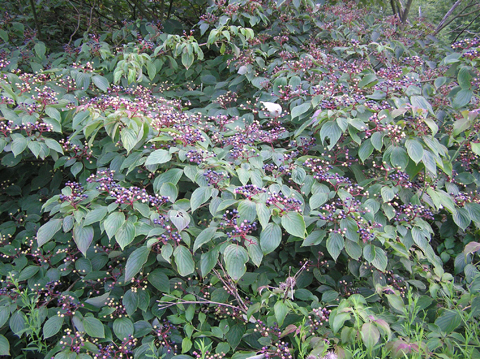
Pagoda dogwood produces large quantities of fruit
that is easily collected and can be used to promote this plant in natural habitat.
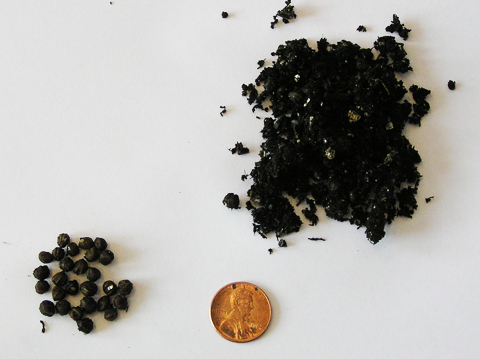
Stratified dogwood seed prior to germination.
This page last updated on January 5th, 2011
this page updated February 20, 2007